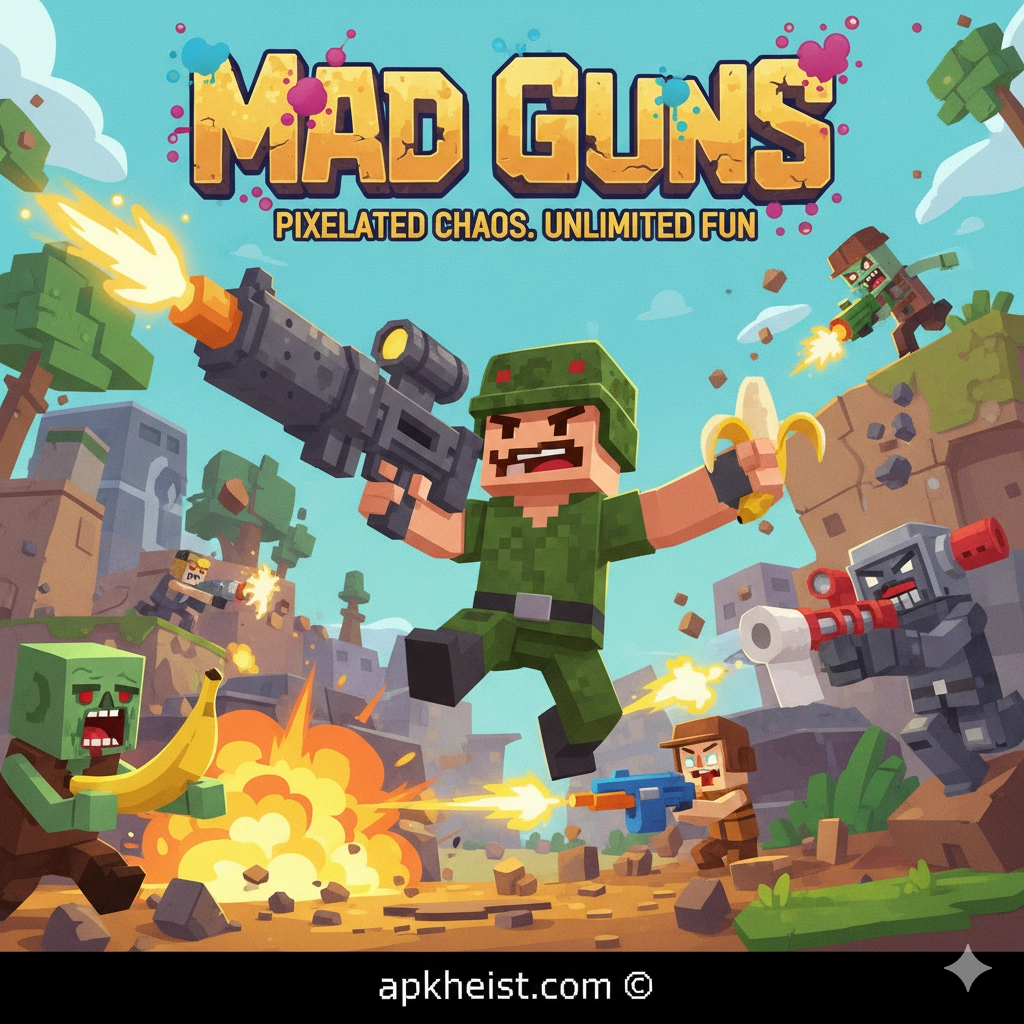
Long intro: Mad GunS Game throws players into an adrenaline-fueled arena where reflexes, positioning, and weapon mastery decide victory. Players navigate compact maps, unlock and upgrade an eclectic arsenal, and face waves of enemies or rival players in modes that range from single-player challenge runs to chaotic multiplayer skirmishes. The game rewards experimentation—every gun has distinct recoil, spread, and utility—so success depends on adapting your loadout to each map and opponent. This guide covers core mechanics, best weapons, progression tips, map strategies, and answers to common questions so you can climb leaderboards and consistently survive longer runs. Below you'll find a compact table of contents followed by deep-dive sections and a practical FAQ. Along the way you'll also see hand-picked internal resources to explore similar games and categories.
1. Gameplay Basics — Quick primer on controls, movement, and match flow.
2. Weapons & Loadouts — How to choose, mod, and combine guns for different playstyles.
3. Maps & Movement — Map-specific tactics, movement tricks, and positioning.
4. Upgrades, Perks, and Economy — Which upgrades to prioritize and how to manage currency.
5. Multiplayer Strategies — Teamplay, solo queue tactics, and counterplay tips.
6. Advanced Mechanics — Technical mechanics, hitboxes, and exploit mitigation.
7. Progression & Endgame — How to grind efficiently and reach top-tier equipment.
Zombie Waves Game: Survive the Night
RealmCraft Game: A Complete Exploratio
Dead Rails: Survive Simulator Game
City Car Drifting Driving Game
Egg Wars Game: The Complete Guide to
Adventure Escape Mysteries Game
1. Gameplay Basics
The fundamentals of Mad GunS revolve around split-second decision-making. Movement is often faster than it appears—strafing and slide-cancel techniques are crucial to avoid incoming fire. Most controls are intentionally simple: an aim, fire, reload, and a dodge or dash. Mastering the reload rhythm is essential because mistimed reloads leave you vulnerable; learn to use cover or movement while reloading. The game typically features short rounds with rapid respawns, so each engagement matters. Map awareness—knowing high-traffic corridors and power-up spawn locations—gives a reliable advantage. Practice aiming under pressure with the game's target ranges; controlled bursts and hip-fire mastery for close-range fights are both needed. Finally, learn to leverage the environment: explosive barrels, high ground, and choke points can convert a defensive position to a winning one. Focus on surviving the first 30 seconds of every encounter, because players who do are far more likely to come out ahead in the midgame.
2. Weapons & Loadouts
Mad GunS offers a diverse weapon pool—pistols, SMGs, assault rifles, shotguns, sniper rifles, launchers, and experimental gadgets. Each class fulfills a role: shotguns dominate tight corridors; SMGs punish missed aim with high mobility; snipers reward map knowledge and patience. Build loadouts based on map size and your role. For small maps, prefer short-range powerhouses with fast reloads; for open maps, bring mid-to-long-range weapons and position for sightlines. Attachments and mods change weapon behavior significantly—improvements to handling may be safer for most players than raw damage boosts. When constructing a loadout, consider pairing a reliable backup (fast-firing pistol or SMG) with a high-risk/high-reward primary (sniper or launcher). Synergy beats raw power: a stable weapon with complementary utility (smoke, stun, or dash) often outperforms an uncooperative “glass cannon” build. Experiment in bot matches to learn recoil patterns and optimal engagement ranges.
3. Maps & Movement
Each map in Mad GunS has signature features—vertical shafts, narrow alleys, open courtyards, and destructible cover. Learn spawn locations and rotate predictably but unpredictably: use common rotation lanes to reach objectives, but vary your timing to avoid predictable ambushes. Movement options such as dashes, slides, and ledge grabs let skilled players traverse maps much faster; combine these moves with strafing to make yourself a difficult target. Use sound cues and visual map markers to anticipate enemy behavior. When pushing an objective, clear common hiding spots and employ suppressive fire to force defenders into poor positions. In free-for-all modes, the ideal strategy is constant motion—set traps, bait enemies into crossfires, and retreat to pick safer angles when necessary. Remember: movement is your primary defense in solo engagements.
4. Upgrades, Perks, and Economy
Your in-match and meta-game economies shape what you can bring to encounters. In-match currencies buy temporary perks, ammo resupplies, and consumables—prioritize items that increase survivability early, such as armor plates or heal packs, and save for offensive upgrades in the mid-to-late game when engagements become decisive. The meta progression system typically unlocks permanent perks and weapon variants; prioritize perks that complement your playstyle and cover weaknesses. If you prefer aggressive play, pick perks that boost mobility and reload speed; if you favor a tactical role, choose passive detection perks and enhanced armor. Efficient currency management is critical: spending too early on flashy one-offs hurts long-term consistency, while hoarding prevents you from responding to immediate threats. Use cost-to-impact analysis when choosing upgrades—small, consistent wins compound more reliably than big, risky gambles.
5. Multiplayer Strategies
Team modes demand coordination. Assign roles—point, flanker, suppressor—and select weapons accordingly. Good teams communicate power-up timers, enemy positions, and health status. Solo players should adapt: if the team lacks a flanker, attempt to create openings; if lacking a support, play more conservatively to avoid feeding the enemy. Use crossfires and baiting to funnel enemies into lethal zones, and always support push attempts with at least one player controlling the retreat path. For ranked play, consistency beats highlight-reel plays: play the objective, keep deaths low, and collect assists. Pay attention to cooldowns on team abilities—timing them together creates decisive advantages. Finally, analyze replays to identify predictable tendencies in your play and the opposition; structured review accelerates improvement faster than raw time spent grinding.
6. Advanced Mechanics
Advanced players exploit fine-grained mechanics: headshot multipliers, precise recoil compensation, and game-specific physics like bump-steering or sprint-canceling. Understand how the engine calculates damage falloff and adjust your engagements to weapon effective ranges. Learn to pre-aim common choke points and to predict enemy input based on movement momentum—anticipation reduces reaction-time requirements. Use reload-cancel tricks where permitted by the game to shave fractions of a second off your downtime. However, be mindful of the game's anti-exploit measures: techniques that rely on glitches can be patched and may carry penalties. Study frame-timing for high-tier maneuvers and practice them in controlled environments. Advanced mechanics are high-investment, high-return—focus on a few that match your main weapons instead of trying to master every trick at once.
7. Progression & Endgame
Endgame progression in Mad GunS typically unlocks prestige tiers, cosmetic rewards, and late-stage gear. Efficiency matters: complete daily and weekly objectives that align with your preferred mode to maximize time-to-reward. For grind-heavy progression systems, create short, repeatable routines—e.g., clear a specific map or mode that yields the best XP per minute. Preserve your sanity by alternating between focused grinding sessions and casual play to avoid burnout. When you reach endgame tiers, the marginal gains from upgrades shrink; at that point, focus on skill refinement, team synergy, and optimizing small decision points that accumulate over matches. Use analytics if available—K/D trends, accuracy by weapon, and preferred engagement ranges—to tune your approach and identify where to invest remaining upgrade points.
FAQ 1: What is the best beginner weapon in Mad GunS?
Beginners should choose weapons with low recoil and forgiving aim—typically an SMG or an assault rifle with controllable spread. These weapons allow you to focus on positioning and movement while you build aim and map knowledge. Prioritize handling and reload speed over peak damage at first.
FAQ 2: How do I get better at aiming under pressure?
Practice in short, focused sessions: aim training maps or bot matches help. Drill fundamentals—target tracking, flick shots, and burst control. Also practice breathing and micro-pauses to avoid frantic spraying. Incrementally increase pressure by adding time or movement constraints until your aim stabilizes under stress.
FAQ 3: Which perks are must-haves?
Must-have perks depend on your role, but universally valuable options are those that improve survivability (armor, passive healing), mobility (reduced cooldowns on dashes), and utility (additional ammo or detection). Choose perks that patch consistent weaknesses in your play rather than chasing meta fads.
FAQ 4: Are cosmetics purely visual or do they affect gameplay?
In most implementations, cosmetics are visual only and do not affect gameplay. However, some games may have visual attachments that slightly alter perception (e.g., larger scopes, flashy skins that make you more visible). Check the game’s item descriptions to confirm whether any cosmetic carries gameplay effects.
FAQ 5: How should I approach ranked matches?
Prioritize consistency and communication. Focus on minimizing unnecessary deaths, playing the objective, and using safe, repeatable strategies. If possible, queue with at least one trusted teammate to reduce variance and improve coordination.
FAQ 6: Is the game pay-to-win?
That depends on the specific title's monetization model. If powerful weapons and upgrades are locked behind real-money purchases and unbalanced by skill-based matching, then the game may tilt toward pay-to-win. Evaluate the in-game shop and whether paid items are purely cosmetic or mechanically advantageous.
FAQ 7: Where can I find similar games and further reading?
Explore titles and articles on arcade shooters and survival-action games to diversify your experience—examples include guides like Zombie Waves Game: Survive the Night, RealmCraft Game: A Complete Exploratio, and community resources on survival and arena shooters. The links provided above lead to deeper articles and genre categories you may find useful.